When does a chatbot become a channel?
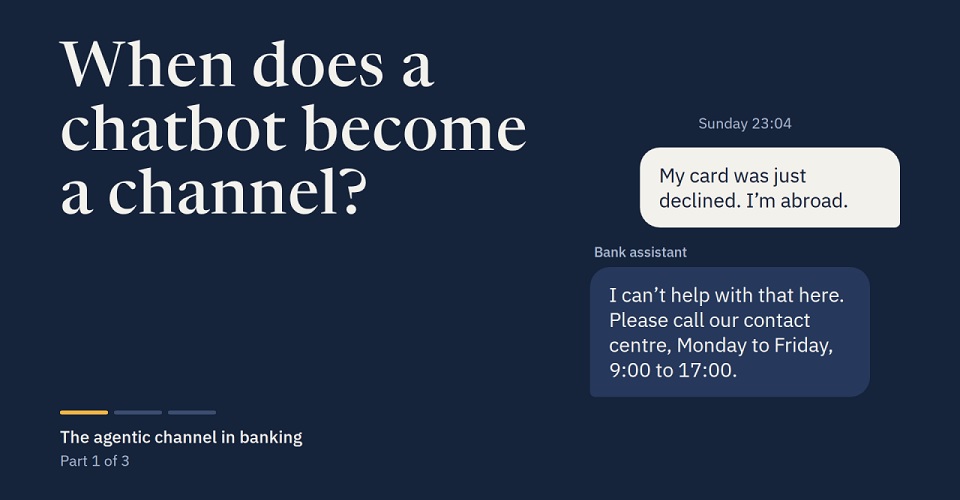
Part 1 of 3: notes on the agentic channel in banking
It is 11pm on a Sunday and a customer’s card has just been declined abroad. She can wait until Monday, queue for the contact centre, or ask the chatbot, which will politely tell her how to reach the contact centre.
I have been trying to understand what it would take for that conversation to end with the card working again. This is the first of three short articles on what I have learned so far. Some of it is still open, and I am happy to be corrected.
An article written by Razvan Dumitru, CTO at IT Smart Systems
Deflection is not resolution
The distinction I find most useful is between deflection and resolution. A chatbot is usually measured on deflection: did the customer go away? What matters to the customer is resolution: was the problem solved? The chatbot in the story deflected her. It resolved nothing.
The gap shows up in the numbers. A customer who is deflected but not helped still calls, and arrives more frustrated. Containment can look healthy on the dashboard while repeat contacts and NPS say otherwise.
An agent is different because it can act. It knows who the customer is, sees their accounts, follows your procedures and completes the request. When it can’t, it hands over to a colleague with the full context, so the customer doesn’t start again.
Where the value seems to sit
A simple way to look at it is these three levels:
- Inform: what a fee is for, how to apply.
- Personalise: why was I charged this fee, where is my transfer.
- Act: unblock the card, raise the limit, dispute the charge.
In most banks, level one is largely covered by the website already. What still reaches the contact centre is mostly levels two and three. The figure I hear most often is that up to a quarter of the volume is repetitive servicing, though your own data will tell you more than any benchmark.
This is where the outcome is. Done well, an agent can resolve in ninety seconds what takes fifteen minutes in a queue. For the customer with the declined card, that means a working card tonight, without waiting for Monday. Cost to serve and digital NPS, two numbers that usually pull against each other, can improve together. And your people get more time for the conversations that need a human.
Why it is hard to get past level one
Each level up needs more trust. To personalise, the agent needs customer data. To act, it needs to change things in your systems. The risks are real: an agent can overreach, be manipulated by a cleverly worded message, or be tricked into revealing data.
So before an agent moves beyond level one, three questions need a good answer.
- Who is the agent acting for, and how do we know?
- What is it allowed to do, and who decided?
- Can we show afterwards exactly what it did?
Without those answers, the agent stays at level one and the business case stays on a slide.
Security as the enabler
It is tempting to see security as the brake on this channel. I have come to think it is closer to the opposite: it decides which level you are allowed to reach, and so how much of the outcome you capture. My bet is that the banks able to show that every agent action was properly authorised will be the ones that scale this channel first.
If that is right, the advantage won’t come from having the best model. It will come from being the bank that regulators trust and customers are happy to use.
A question for your own programme: what share of conversations end with the customer’s request completed and no human involved? If it is close to zero, it is probably still a chatbot rather than a channel.
Next: those three questions in more detail, and why existing controls struggle to answer them. Then, the approach we are taking to authorising what an agent does. Does this match what you see in your own channels?