Rain introduces wallets, putting the account at the center of its stablecoin payments platform
Partners get wallets, cards, virtual accounts, and payouts from Rain through one integration, keeping their choice of chains, stablecoins, and networks.
Key Facts:
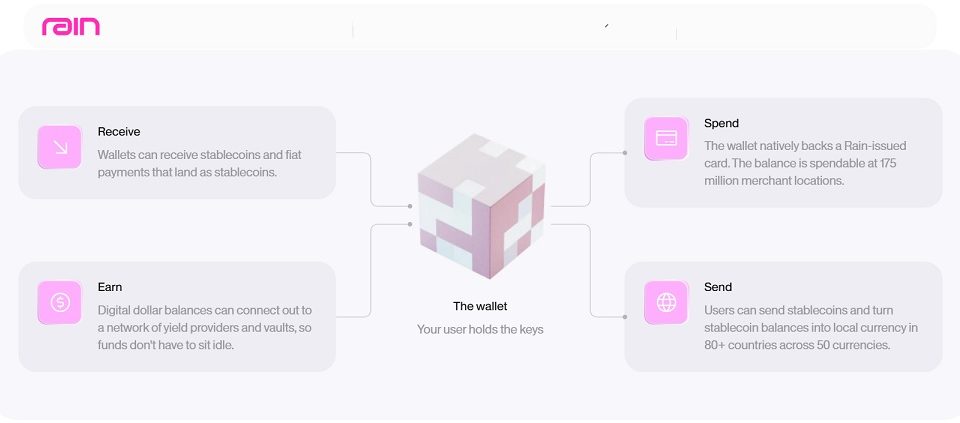
- Stablecoins that work like any other money: Rain non-custodial wallets let users get paid, save, earn, spend, and send from a single stablecoin balance.
- Spending built in: Rain wallet balances natively back Rain-issued cards, so users can spend at 175 million merchant locations worldwide.
- Flexibility and Choice: Partners can offer Rain wallets and directly connect to Rain’s cards, rewards, onramps, offramps, and payouts. Rain wallets support twelve blockchains, so partners are not tied to one chain or one stablecoin.
- Simple and secure: Partners can embed Rain wallets directly into their apps to make it easy for users to get started. Users easily sign in with a passkey or a code sent to their email or phone instead of a seed phrase.
- Availability: Non-custodial Rain wallets, where users hold their own keys, are available to Rain partners today. Custodial wallets and additional features to help users earn on their stablecoin balance will be available before the end of the year.
Rain, the global stablecoin payments platform, announced Rain wallets, embedded stablecoin wallets that partners can offer their users inside their own apps, with the ability to earn on balances to follow by end of year. “The wallet is the account at the center of Rain’s platform. It is accessible through the same integration that issues the card, powers rewards, and supports money movement, so a user can get paid, save, spend, and send from one balance.” – according to the press release.
Companies bringing stablecoins to their users want them to work the way any other money does. For that to happen, a stablecoin balance needs to connect to everything a user wants to do with it. “Rain wallets put that balance at the center of Rain’s platform, so the full life cycle of money runs in one place, from the moment it arrives to the moment it is spent or sent.” – the company said.
“Consider a freelancer in Mexico paid by a U.S. client. Her pay is sent in dollars to her virtual account and lands in her Rain wallet as stablecoins, with no manual conversion. She can spend that afternoon at any of the 175 million merchant locations where her Rain-issued card is accepted, or she can access additional ways to earn on balances directly in her app. When she needs pesos, she can send them straight to her local bank account using Rain’s global payouts. The entire experience lives inside one app, and it’s all powered by Rain’s infrastructure.” – the company explained.
“When a company builds with stablecoins, the first thing its users need is a place to hold them,” said Pooja Shah, Head of Product at Rain. “Rain wallets are that place. Because they are integrated into the broader Rain stack, every balance is ready to use the moment it arrives. Partners can get all of it from Rain, or keep the wallet they have and plug it into everything else we run.”
How Rain wallets fit into Rain’s full-stack platform
The wallet is the account at the center of Rain’s full-stack platform, the place where a partner’s users hold their stablecoins and the balance every other Rain product draws on. Rain started by making stablecoins spendable through cards and is now powering all onchain experiences through the wallet. A balance can arrive through a virtual account or onramp, fund a card, be put to work, and be sent to a bank account in local currency without ever leaving the partner’s app. For enterprises, that means one vendor integrating the full flow of funds, and every product a partner adds works with the ones they already run.
While Rain offers the convenience of an end-to-end platform, its infrastructure is also built to be open and interoperable. Partners that already work with a wallet provider can connect it to Rain’s cards, rewards, onramps, and payouts. Rain wallets support multiple stablecoins and other crypto assets across major blockchains, giving partners the flexibility to choose which assets or networks best fit their business.