Chime bought a bank. Now it has to pay for one.
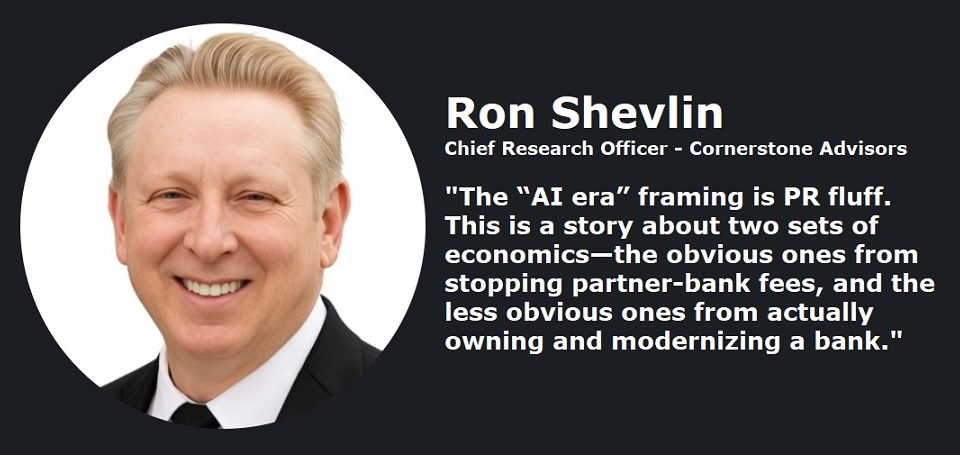
Article written by Ron Shevlin – Chief Research Officer at Cornerstone Advisors
Chime announced its intention to acquire longtime partner Stride Bank for $590 million in cash. Expected close: first half of 2027. More than $100 million in claimed net synergies. Assets to stay under $10 billion “for the foreseeable future.” Chime will keep working with The Bancorp Bank.
In the announcement, Chime framed the deal as creating “an end-to-end platform built for the AI era.” The key bullet: integrating ChimeCore, its “AI-native” proprietary stack, with Stride’s banking infrastructure to unify data and decisioning and reduce handoffs—delivering “faster product innovation for the AI era.”
My take: The “AI era” framing is PR fluff. This is a story about two sets of economics—the obvious ones from stopping partner-bank fees, and the less obvious ones from actually owning and modernizing a bank.
Chime’s Lawyers Told the Story Better
Wachtell, Lipton, Rosen & Katz, Chime’s legal counsel on the transaction, published a memo the same day the deal was announced. It lays out the full strategic case for a fintech owning a bank: complete control over products, services, credit decisions and data ownership; stable low-cost deposit funding that holds up in periods of market dislocation; and escape from the patchwork of state money-transmitter licenses.
AI doesn’t appear anywhere in that case. Chime’s counsel and Chime’s communications team published on the same day and didn’t share a thesis.
Britt described the actual bottleneck two days later at a Goldman Sachs conference: working through partner banks meant redundant steps in legal and compliance review. Chime had its risk tolerance, the bank had its own, and as Britt put it, “we’re both mostly right.” He wouldn’t say the arrangement had blocked product launches, but “there’s no question that we haven’t been able to move as fast as we would like.”
Two compliance functions with different risk settings is the problem. Owning one of them is the solution—not AI.
The First Economics: Stop Paying the Bank
Chime has been renting regulated banking infrastructure for years. By owning Stride, it eliminates those fees and captures more of the economics from its deposits, payments, and lending. That’s real money. More than $100 million in net synergies against 2026 adjusted EBITDA guidance of $481–489 million is roughly a 20% profitability lift before any extra lending upside.
At more than 10 million active members and a large payments business, the math of paying someone else for the pipes has changed. Owning the infrastructure starts looking better than renting it.
The Second Economics: Start Paying For the Bank
Stride is a $5.4 billion bank with the technology, operations, compliance, risk, cybersecurity, and regulatory infrastructure required to run one. Chime’s been paying to access those capabilities. Now it owns the institution and has to fund them itself.
The Wachtell memo is direct about why that bill is bigger than it looks. Fintechs partner with banks under $10 billion to avoid the Durbin cap, so partner banks tend to be community banks that are less technologically sophisticated than the fintechs they serve, which produces product limitations and cybersecurity risk.
That’s the buyer’s counsel describing the asset class the buyer just bought. The technology gap that made the partner-bank model frustrating doesn’t close at signing. It moves onto Chime’s income statement.
Chime isn’t only buying its own program, either. Stride runs a broader book with other fintech partners, including Affirm. William Blair flagged that as execution risk, noting that M&A is hard even when the strategic rationale is compelling. Chime has to decide what to keep, what to exit, and what to price differently, and every one of those decisions has a revenue consequence.
Wachtell’s downside list includes capital and liquidity requirements at both the holding company and the bank, which reduce what’s available to invest in the business, and regulatory pressure to become profitable on a GAAP basis. Second-quarter revenue was $670 million and GAAP net income was $28 million. Bank holding companies get graded on the second number.
Chime estimates the benefit at “more than $100 million in net synergies,” so some of those costs may already be netted. But the company has given no detail on how much of the savings will be consumed by the investment required to bring Stride’s infrastructure up to the standards Chime wants—or how long that takes.
The important question is how much of the partner-bank savings survive after Chime assumes the ongoing cost of running, modernizing, and upgrading the bank.
Why Stay Below $10 Billion?
Banks under $10 billion in assets qualify for the small-issuer exemption from the Fed’s debit interchange caps. Interchange is a core piece of Chime’s business, so preserving the exemption is rational.
What’s less rational is calling it a choice. Truist’s Brian Finneran points out that combined Chime and Stride assets already sit around $7 billion. With 10.4 million customers and an average account size around $1,000, staying under the line while growing “looks tough,” and Chime may have to sell loans faster or trim parts of Stride’s existing business to hold it.
Chime doesn’t get to decide when the ceiling matters. Deposit growth decides that.
That makes the comparison to SoFi instructive. SoFi took the same route, buying Golden Pacific Bank in 2022, injecting capital, and building it into a bank with more than $50 billion in assets. Chime bought a bank and committed to keeping it roughly where it is. Same acquisition path, opposite use of the asset.
So the strategy is more interesting than “becoming a bank,” but also more constrained than the announcement suggests. Chime is buying the bank because owning the infrastructure improves the economics of the fintech business it already has. What it’s buying in optionality is thinner than the headline implies.
The $590 million question is whether those improved economics survive the cost of owning the bank.