Banks love stablecoins (just not the ones that pay you)
The Wall Street Journal published an article titled Banks Fought Against Stablecoins. Now They Are Considering Launching Their Own. The news (i.e., factual) part of the story:
- JPMorgan discussed issuing its own stablecoin, on top of JPM Coin, its existing tokenized deposit product. There’s no active product underway, but the bank says it would evaluate its options as customer demand and regulation develop.
- A group of more than a dozen banks, including Bank of America, Wells Fargo, and Santander, is advancing a joint stablecoin venture covering the dollar first, with the euro and other G7 currencies to follow.
- Thirty-nine state banking associations representing about 3,000 banks unveiled the BankChain Alliance, a bank-owned blockchain platform targeting a 2027 launch to support both tokenized deposits and stablecoins.
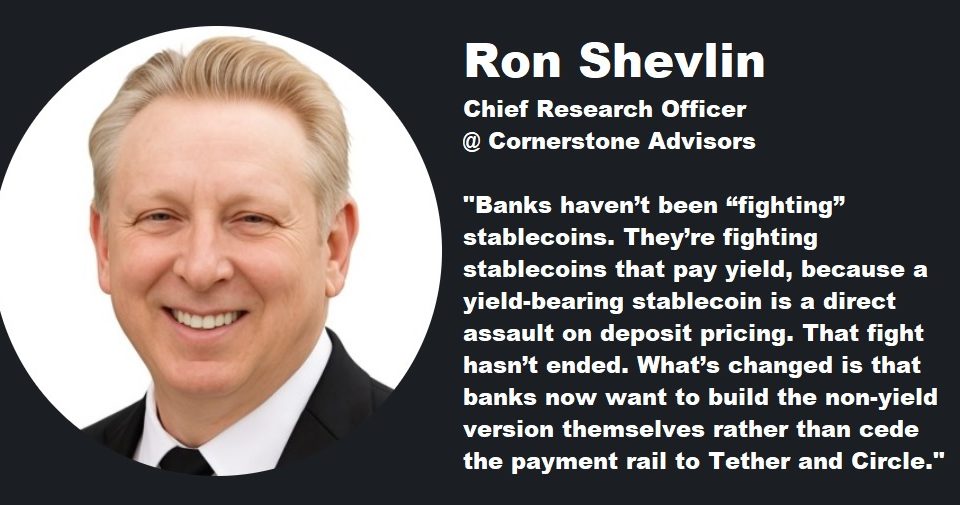
My take: Banks haven’t been “fighting” stablecoins. They’re fighting stablecoins that pay yield, because a yield-bearing stablecoin is a direct assault on deposit pricing. That fight hasn’t ended. What’s changed is that banks now want to build the non-yield version themselves rather than cede the payment rail to Tether and Circle.
an article by Ron Shevlin, Chier Reserch Officer at Cornerstone Advisors
What Banks Are Fighting
The Journal’s “banks embrace stablecoins” framing as one decision is off-base.
A stablecoin that pays no yield is a payment rail. A stablecoin that pays yield looks a lot more like a deposit or savings account, except the issuer doesn’t carry the same reserve requirements, capital rules, or deposit insurance costs that banks do.
From a bank’s perspective, that’s the problem. The technology isn’t what threatens the deposit franchise; the economics are.
That’s why banks can live with the first and have started building it themselves. They can’t live with the second, which is why the yield question stayed in the Clarity Act fight rather than getting resolved alongside everything else.
Reporting the current wave of bank stablecoin activity as a reversal of the banks’ position on stablecoins misses the real story: banks embrace the payment rail as long as they can keep someone else from using it to reprice the deposit market.
The Interoperability Trade-off
Tokenized deposits are generally built around permissioned infrastructure, where participating banks can control who gets access and how transactions are processed. That works well when the objective is to make existing banking transactions more efficient, particularly around settlement and reconciliation.
Stablecoins solve a different problem. Their appeal comes from being able to move across public blockchain networks such as Ethereum and Solana and interact with parties outside a particular bank or banking consortium.
I’ve made this distinction before: tokenized deposits solve an efficiency problem—reconciliation. Stablecoins solve an effectiveness problem—payments. A bank that builds tokenized deposit infrastructure but ignores stablecoins risks modernizing its back office while leaving the broader payments battlefield to Circle and its successors.
Brookings’ Aaron Klein argued that tokenized deposits solve the programmable-money problem without requiring new infrastructure, and he’s not wrong about the narrow use case. If the money only needs to move among institutions participating in the same network, there’s a strong argument for keeping it inside the banking system.
The problem comes when the counterparty isn’t in the network. At that point, the walled garden that made the tokenized-deposit system attractive becomes a constraint. Banks needs a form of digital money that can move beyond its own infrastructure and interact with the broader ecosystem on networks it doesn’t control.
That’s why the BankChain Alliance is building support for both formats rather than picking one. Tokenized deposits can handle transactions that stay inside the banking system, while stablecoins can provide a way to move money outside it.
The two aren’t necessarily competing answers to the same problem; they’re complementary pieces of a broader payments infrastructure.
What This Means for Community Banks and Credit Unions
I wrote in June that the megabanks’ Clearing House tokenized deposit network was a press release about a press release: no vendor chosen, no name settled, and “modest” client demand by Bank of America’s own admission.
The new WSJ article doesn’t change that verdict, but it sharpens the more important point underneath it: the big banks clearly see blockchain-based money movement as infrastructure worth owning, even if they don’t know which version will win.
JPMorgan can afford to evaluate a proprietary stablecoin on its own blockchain. Most community banks and credit unions can’t, and shouldn’t try. The more interesting opportunity is shared infrastructure that gives smaller institutions access to the same capabilities without requiring each one to become a blockchain company.
That’s what makes the BankChain Alliance worth watching. It’s essentially applying the shared-infrastructure model that the Federal Home Loan Bank system has already demonstrated can work across thousands of smaller institutions to a new piece of financial infrastructure.
Cari Network, led by former Comptroller of the Currency Gene Ludwig, is furthest along. It’s anchored to Ethereum, issues FDIC-insured deposit tokens, and selected Prividium as its infrastructure, a private permissioned chain built to let regulators audit activity without exposing transaction data to other participants.
Whether Cari, BankChain, or another effort ultimately becomes the dominant infrastructure matters less to a community institution today than the fact that the infrastructure layer is beginning to take shape.
Community banks and credit unions need to understand what participation in a tokenized deposit network would mean for their payments strategy, their deposit economics, and their ability to move money outside their existing networks.