80% of financial services firms in UK reported having AI agents deployed while a further 14% reported plans to deploy them over the next 12 months – Bank of England research

The use of generative artificial intelligence by financial services firms in the UK has exploded in the last two years, now accounting for more than half of all AI systems, according to survey from the Bank of England and FCA.
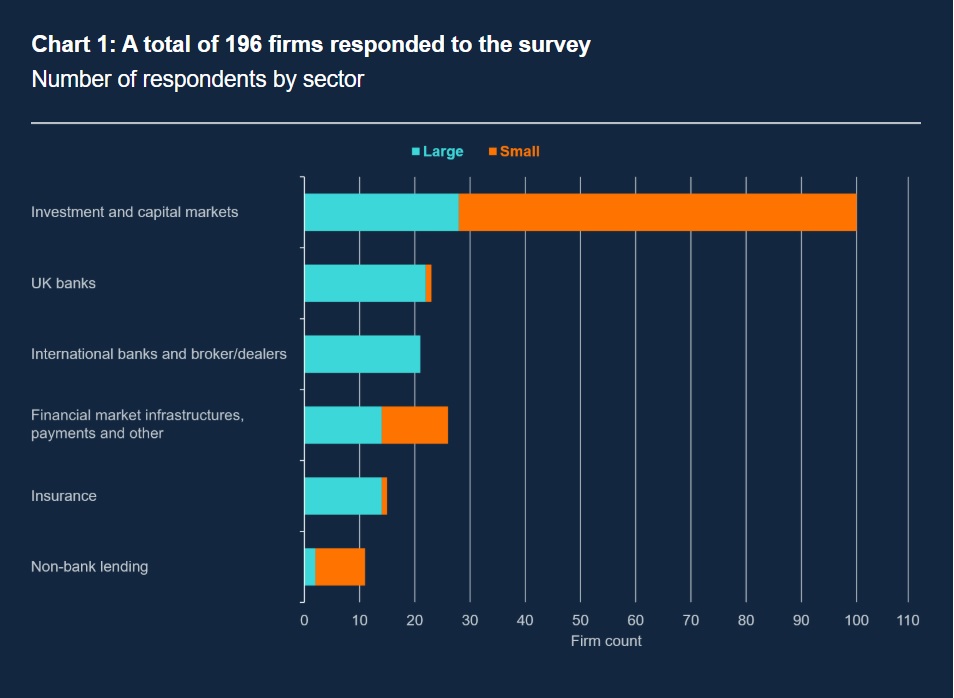
Of 196 respondents to the survey, 86% report using AI, up from 75% in 2024. In that time, the technology mix has shifted, with GenAI accounting for 56% of all reported AI systems, compared with 17% for foundation models in 2024.
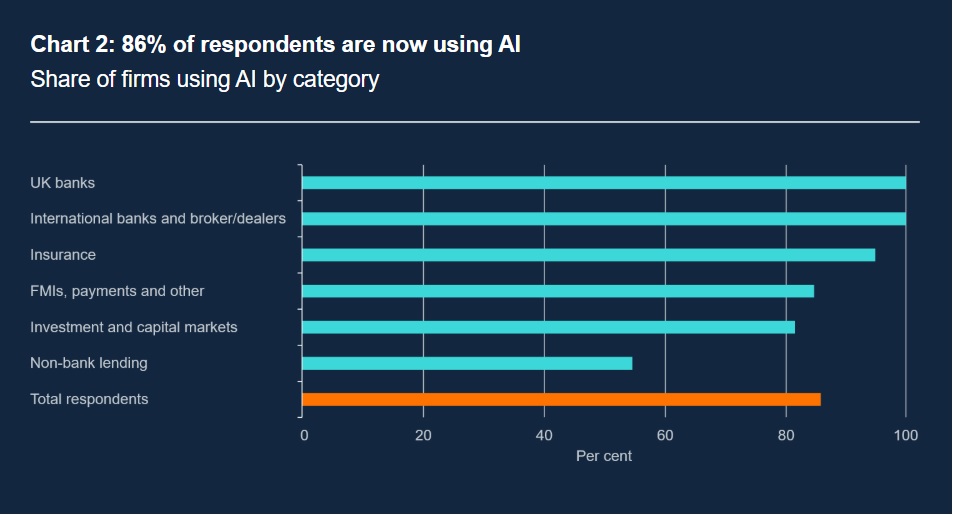
AI deployment was near-universal among respondents to the full survey. The full survey also asked firms about the number of AI systems at different stages of the AI lifecycle. 94% reported having at least one AI system in production, rising cumulatively to 97% when systems in pilot or proof-of-concept were included, and to 99% when planned deployments over the next 12 months were also included.
Amongst respondents to the full survey, the median number of AI systems in production varied across sectors, with international banks and broker-dealers reporting the highest median (43 systems), followed by UK banks (22 systems), and insurance (18 systems).
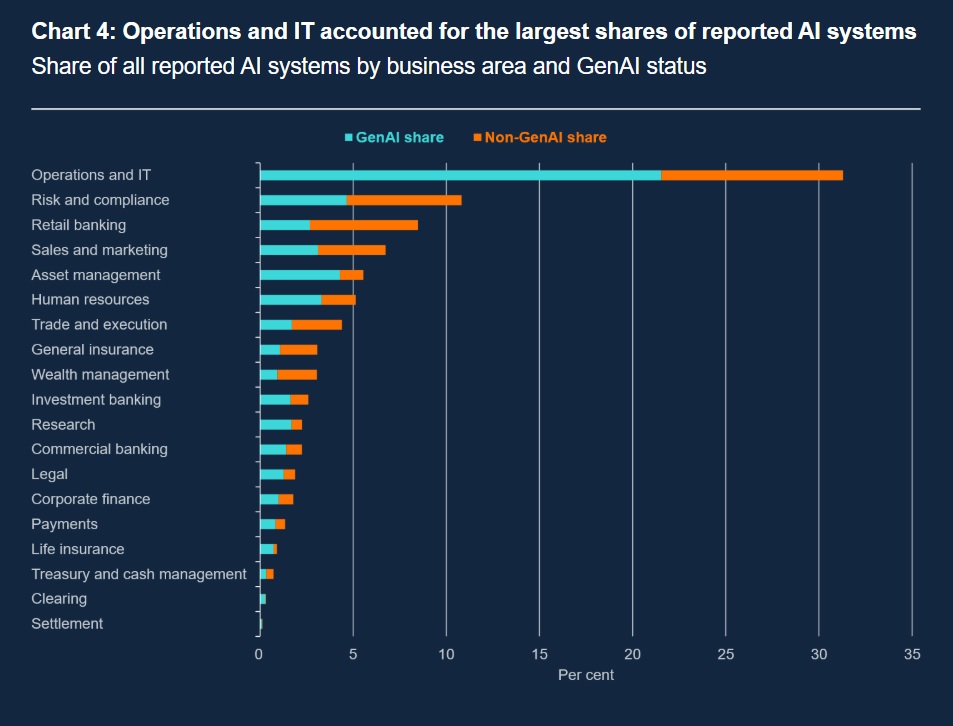
Use of AI systems by business area
AI use is spread across business areas but remains concentrated in operations and IT, which accounts for 31%, up from around 22% in 2024. No other individual area accounts for more than 11%.
AI agents – adoption and use
The full survey asked respondents about their use of AI agents. Firms were asked about the types of AI agents they were currently using and expected to use.
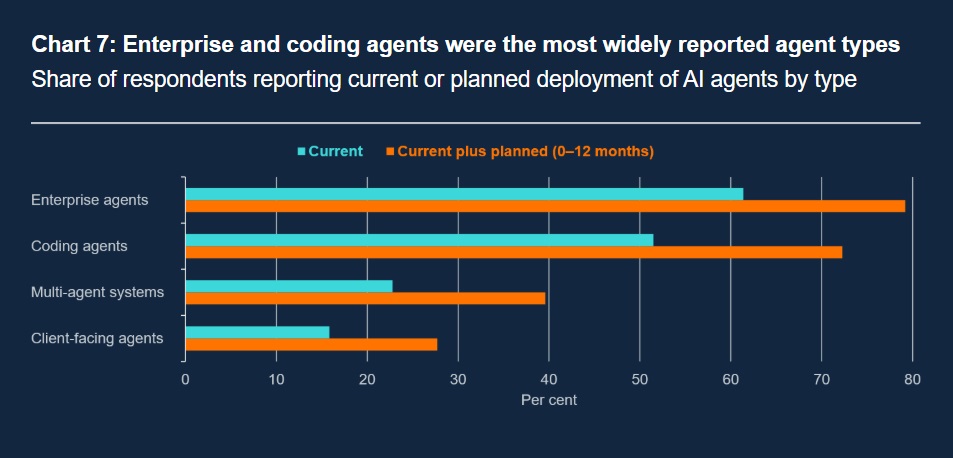
Reported AI agent adoption was widespread and was expected to increase further. 80% of respondents reported having AI agents currently deployed while a further 14% reported plans to deploy them over the next 12 months. Enterprise and coding agents were the most widely deployed types, while client-facing agents were less prevalent. Planned deployment over the next 12 months was expected to increase adoption across all agent types, with the largest increase for multi-agent systems (Chart 7).
The full survey asked firms to report AI agents in production by business area and level of autonomy, namely:
- ‘decision-support’ (agents recommend actions, humans decide and execute),
- Constrained execution (agents execute actions within predefined limits and rules),
- Conditional autonomy (agents act independently but require human approval for certain actions), and
- Broad autonomy (agents can initiate and execute actions with limited real-time human involvement).
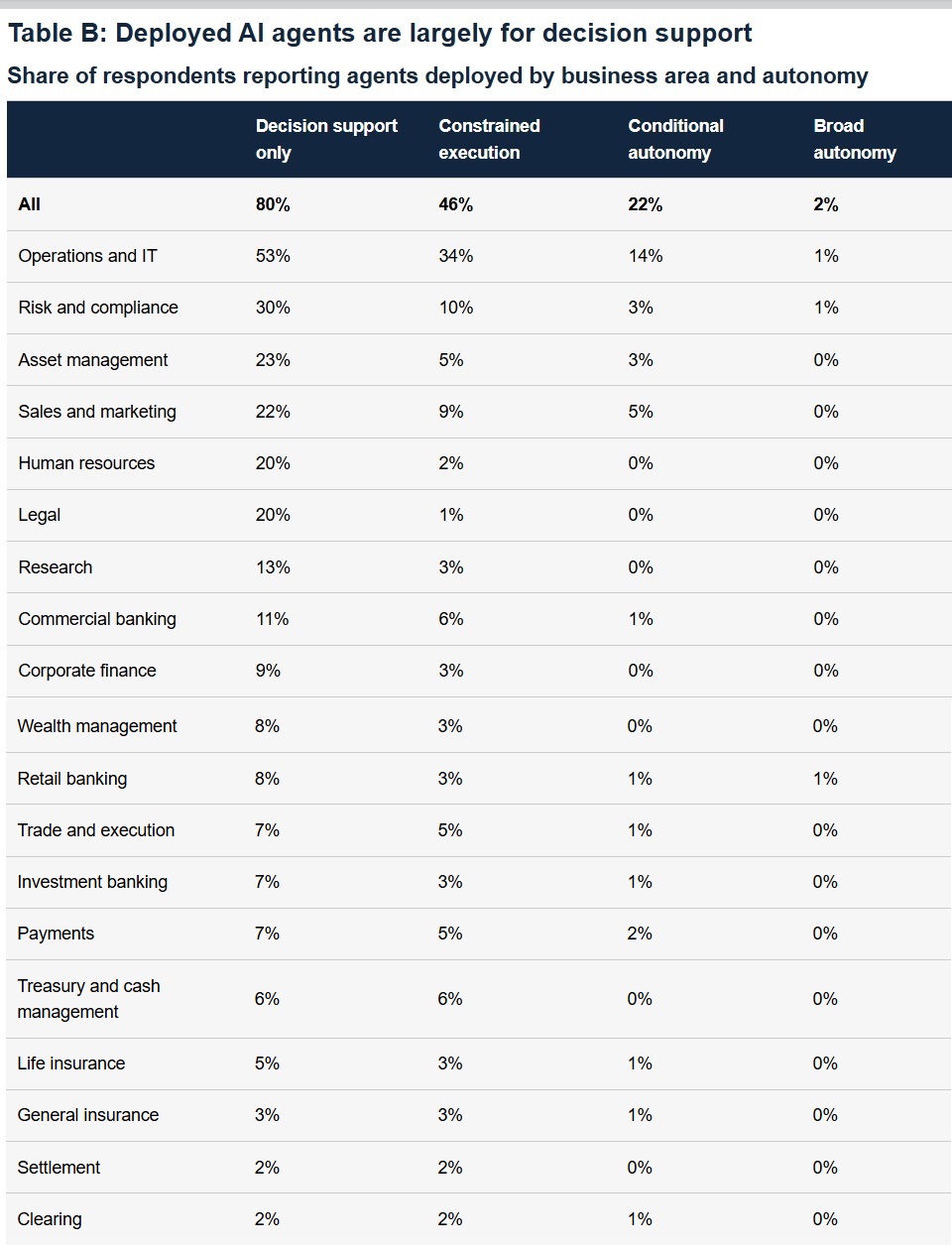
AI agent deployment is widespread, but autonomy is limited. 80% of respondents reported having AI agents deployed for decision support, 46% reported having agents deployed with constrained execution, 22% reported having agents deployed with conditional autonomy, and only 2% reported having agents deployed with broad autonomy. Where AI agents were reported to have greater levels of autonomy, they were most likely to be deployed in Operations and IT, Risk and Compliance, and Sales and Marketing (Table B).
Current and planned deployment of AI agents varied across functions. 16% reported current use of agents for automated customer communications, rising to 34% when planned deployment was included. For creating or modifying records in core systems, the corresponding figures were 8% and 25%. By contrast, even including planned deployment over the next 12 months, no more than 9% of respondents expected agents to: approve or decline customer outcomes; execute trades or place orders; initiate, execute or block payments; or change limits, thresholds and controls.
Methodology
In previous surveys, all respondents completed the same full questionnaire. In 2026, to encourage participation from smaller firms, firms with fewer than 100 employees were given the option to complete a shorter questionnaire requiring less detailed information on their AI systems, although they could still choose to complete the full survey. Of the 196 respondents, there were 101 larger firms and 95 smaller firms. In total, 105 respondents completed the full survey. Unless otherwise stated, the figures presented in this report are based on responses to the full survey, to aid comparability with previous surveys.
Definitions
An AI system is defined as a machine-based system that, for explicit or implicit objectives, infers, from the input it receives, how to generate outputs such as predictions, content, recommendations, or decisions that can influence physical or virtual environments. Different AI systems vary in their levels of autonomy and adaptiveness after deployment.
AI agents can be understood as a subset of AI systems that perceive and act on their environment with a degree of autonomy, using tools as needed to achieve specific goals and adapt to changing inputs and contexts.
Agentic AI generally refers to systems composed of multiple co-ordinated AI agents that can break down tasks, collaborate and pursue complex objectives autonomously over extended periods. Agentic AI systems are designed to operate in more open-ended, less predictable physical and virtual environments, and to function with minimal human supervision.