Finextra & ACI Worldwide launch global survey report: ‘Payments 2030: The Payoff Year’
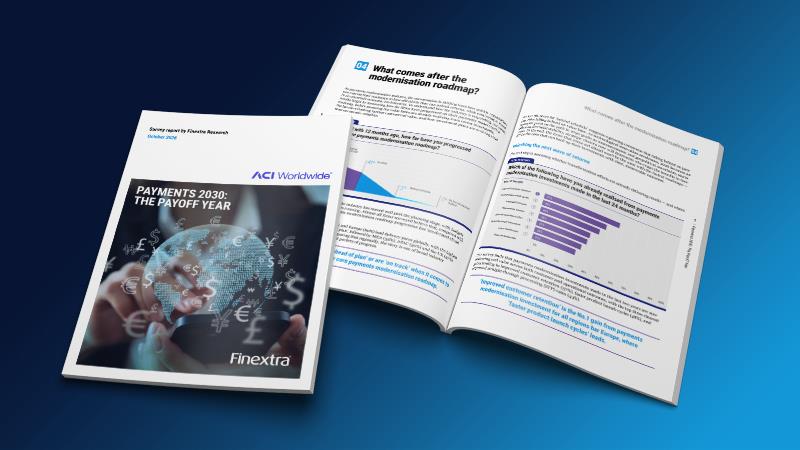
Finextra has released ‘Payments 2030: The Payoff Year‘, exploring the priorities financial institutions are navigating as the payments landscape continues to evolve, the link between technology adoption and profitability, and whether investment decisions into payments strategies are actually generating commercial value.
Building on last year’s Finextra Payments 2030 survey, this second edition of the global survey, produced in association with ACI Worldwide, surveyed 152 global industry leaders in May 2026. Findings are contextualised through regional analysis as well as exclusive expert commentary from Deutsche Bank, Pay.UK, ING, and the FCA.
This year’s edition centred on three core questions: What comes after the modernisation roadmap? Where are financial institutions directing their investment in 2026? And what’s driving modernisation strategy overall?
The survey data reveals:
- Appetite for investment remains resilient despite macroeconomic volatility: Despite a tougher economic environment, 43% are accelerating investment, compared with 22% pulling back, and 95% feel confident about hitting their 2030 payments strategy goals.
- Data is the new battleground: Data accessibility ranks as the greatest obstacle to unlocking more commercial value from modernisation spend. 77% are already running a unified payments platform or are moving towards one, driven mainly by the need for improved data and insights (32%).
- AI and fraud management have gained strategic importance: AI is delivering measurable value across payments operations, from ISO 20022 data enrichment (34%) to exceptions and investigations (43%). 41% now see fraud controls as a competitive edge, with 61% saying they would give a different answer now than they would have 24 months ago.
- The emergence of new rails: Fintech and PSP competition is the top driver behind A2A and instant payments business cases (45%), ahead of new revenue (28%) and cost displacement of cards and cheques (17%). 41% are actively piloting stablecoin solutions, primarily for cross-border payments, treasury and cash management, and interbank settlement — with just 3% having no plans to engage with stablecoins.
More details here